Catholic prayers for the dead reflect the great hope at the center of our faith: Jesus has conquered the power of sin and death. He demonstrates this fact in His Passion, Death, and Resurrection. For its part, the Church has provided wellspring of prayers not only to provide us with comfort but to intercede for the souls of the deceased.
Let’s journey into the depths of this tradition together to remind us that even in the dark valley Jesus walks with us.
Prayer for Eternal Rest
The following prayer for the dead is often recited in call and response style, but both parts may be read by the same person as well.
Leader: Eternal Rest grant unto them, O Lord.
Response: May their souls and the souls of all the faithful departed, through the mercy of God, rest in peace. Amen.
Prayer of Eternal Rest in Latin
| Latin | English (Literal translation) |
| Requiem aeternam dona eis, Domine. | Rest eternal give to them, Lord. |
| Et lux perpetua luceat eis. | And light perpetual shine upon them. |
| Fidelium animae, | The souls of the faithful, |
| per misericordiam Dei, | by means of the mercy of God, |
| requiescant in pace. | rest in peace. |
| Amen. | Amen. |
Pronunciation Notes
- Aeternam can be pronounced differently depending on whether you are pronouncing according to the typical pronunciation of the Catholic Church (the ecclesiastic pronunciation) or the original pronunciation. The ecclesiastical pronunciation the “ae” would be pronounced as “eh” or “ai” as in the Regina Caeli prayer. The full word would then be pronounced “eh-ter-noom” with the emphasis on the second syllable. The traditional Latin pronounciation would be “eye-ter-num.”
- Like with aeternam, Lux can be pronounced in two ways. In traditional Latin, the “u” would make an “oo” sound like in the word “too.” However, the word “lux” is often read with the short u sound in eccessiastical Latin to sound closer to the Italian pronunciation. In this pronunciation, “lux” would be pronounced like “lucks.”
- English speakers might be tempted to pronounce “animae” like the Japanese cartoon style (anime), but the a is much softer. The correct ecclesiatical pronunciation would be “ah-nee-may.”
- Though “per” is a word in English, “per” is pronounced differently in Latin. Think more like pear (the fruit) with a short open e as in pet. The r should also be lightly trilled.
- Like per, “pace” has English lookalike that sounds different in Latin. Like “caelo” in the Pater Noster, the “c” will sound like a “ch” in English. The resulting pronunication will be “paw-chay.”
Prayer for the Death of a Child
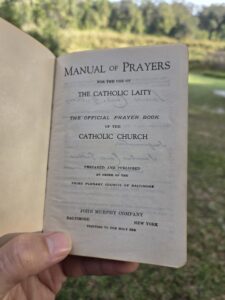
This prayer for the death of a child was taken from the 1916 Manual of Prayers. The prayer presented here is an excerpt of a longer prayer said at the burial of a young child. Originally presented in Latin and Elizabethan English, I have made slight edits to the text to make it easier to understand for modern readers.
Let us pray.
Almighty and most merciful God,
who, when little children born again
at the Font of Baptism depart this world,
does immediately, and without abandoning them,
bestow upon them life everlasting,
As we believe You have done this day
to the soul of this little child:
Grant us, we beseech You, O Lord,
through the intercession
of Blessed Mary ever Virgin
and all of your saints,
to serve you here with pure minds,
and to be forever united
to the Blessed little ones
in Paradise.
Through Christ our Lord.
Amen.
Prayer for the Death of a Parent
This prayer for the death of a parent was taken from the 1916 Manual of Prayers. It is an excellent prayer for deceased parents on All Souls Day.
O God, who has commanded us to honor our father and mother, look in the tenderness of Your mercy upon the souls of my father and mother, and forgive them their sins, and grant unto me the joy of seeing them again in the glorious light of everlasting life.
Amen.
Prayer for the Dead
This Catholic prayer for the dead was originally written for deceased men in the Manual of Prayers. However, it is a beautiful prayer that be said for anyone who has died.
O Lord, incline Your ear unto the prayers whereby we call upon you to show mercy unto the soul of Your servant [the deceased], which you have commanded to depart out of this life; that it may please You to set him in a place of peace and light, and give him a part with your saints.
Amen.
About the Manual of Prayers
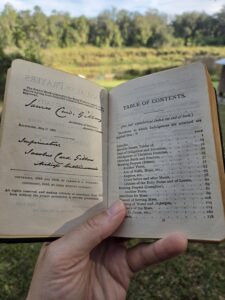
The Manual of Prayers was promulgated by the third plenary council of Baltimore to be used as a Catholic prayer book for the laity. First released in 1888, the version I reference for some of the prayers on this page come from the 1916 edition. Archbishop James Cardinal Gibbons provided his imprimateur for the book on May 17, 1889.
The Catholic prayers for the dead used here have been lightly edited. This was done only where needed to improve understanding for modern readers. I have also attempted to retain the meaning as much as possible.